Vectorize a sports team logo for jerseys and merchandise
Turn an approved team crest into clean SVG variants for jerseys, embroidery, vinyl, print, signs, and digital use.
Quick answer
First confirm that you own the logo or are authorized to reproduce it. Find the highest-resolution approved source, then use Logo to Vector only when the original vector master is unavailable. Correct the geometry against official references and build separate full-color, one-color, reversed, and simplified variants. Test each derivative in its real production process instead of sending one complex SVG to every vendor.
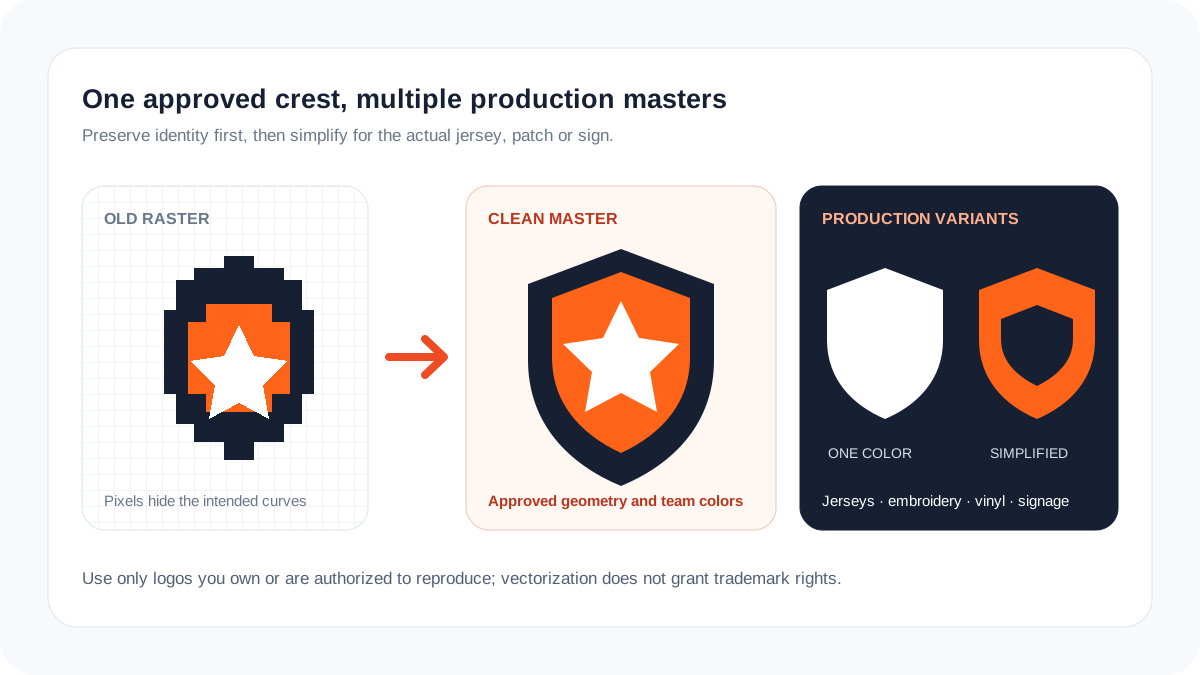
A team identity has to survive extreme scale
The same mark may appear as a small cap embroidery, a chest print, a sponsor board, a vehicle decal, and a stadium graphic. Scaling is only the first requirement: thread, cut vinyl, screen ink, sublimation, and digital displays reproduce detail differently.
Do not silently modernize a historic crest while tracing it. Preserve proportions, letterforms, dates, stars, borders, and official colors. If damaged source material leaves ambiguity, compare multiple authorized references and request approval.
Prepare a variant for each application
| Application | Recommended file | Adjustment |
|---|---|---|
| Jersey print | Full-color SVG/PDF | Spot colors and outlined type |
| Embroidery patch | Simplified vector reference | Open gaps and fewer tiny details |
| Cut vinyl | One-color SVG | Welded shapes and weedable islands |
| Stadium/digital | Clean full-color master | Consistent geometry at large scale |
Team-logo vector workflow
- Collect written authorization, brand guidelines, color references, and the newest approved crest.
- Search existing EPS, PDF, SVG, or design files before tracing a web thumbnail.
- Vectorize the cleanest raster only when no usable master exists.
- Inspect symmetry, lettering, border thickness, negative spaces, stars, dates, and mascot features.
- Create named production derivatives without overwriting the master.
- Send a proof showing version, colors, dimensions, placement, and production method for approval.
Risks specific to sports artwork
- Using an unofficial fan recreation as the reference.
- Adding detail to a mascot that disappears in embroidery.
- Changing team colors by sampling a compressed social-media image.
- Producing third-party trademarks without permission.
Handoff checklist
- Authorization and logo version are documented.
- Official colors and typography match the reference.
- Full-color, one-color, and reversed files are clearly named.
- The smallest physical application was tested.
- The production vendor receives the correct derivative, not the archive master.
Frequently asked questions
Can I vectorize a professional team logo for my own merchandise?
Vectorization does not grant trademark or merchandising rights. Obtain permission from the rights holder before producing or selling goods.
Should embroidery use the same SVG as print?
Use the approved SVG as a reference, but simplify details for the final stitched size and let the digitizer define stitch structure.
What if the only source is an old jersey photo?
Use the straightest, highest-resolution photo and compare it with programs, signage, or other authorized material. Record reconstructed details for approval.